


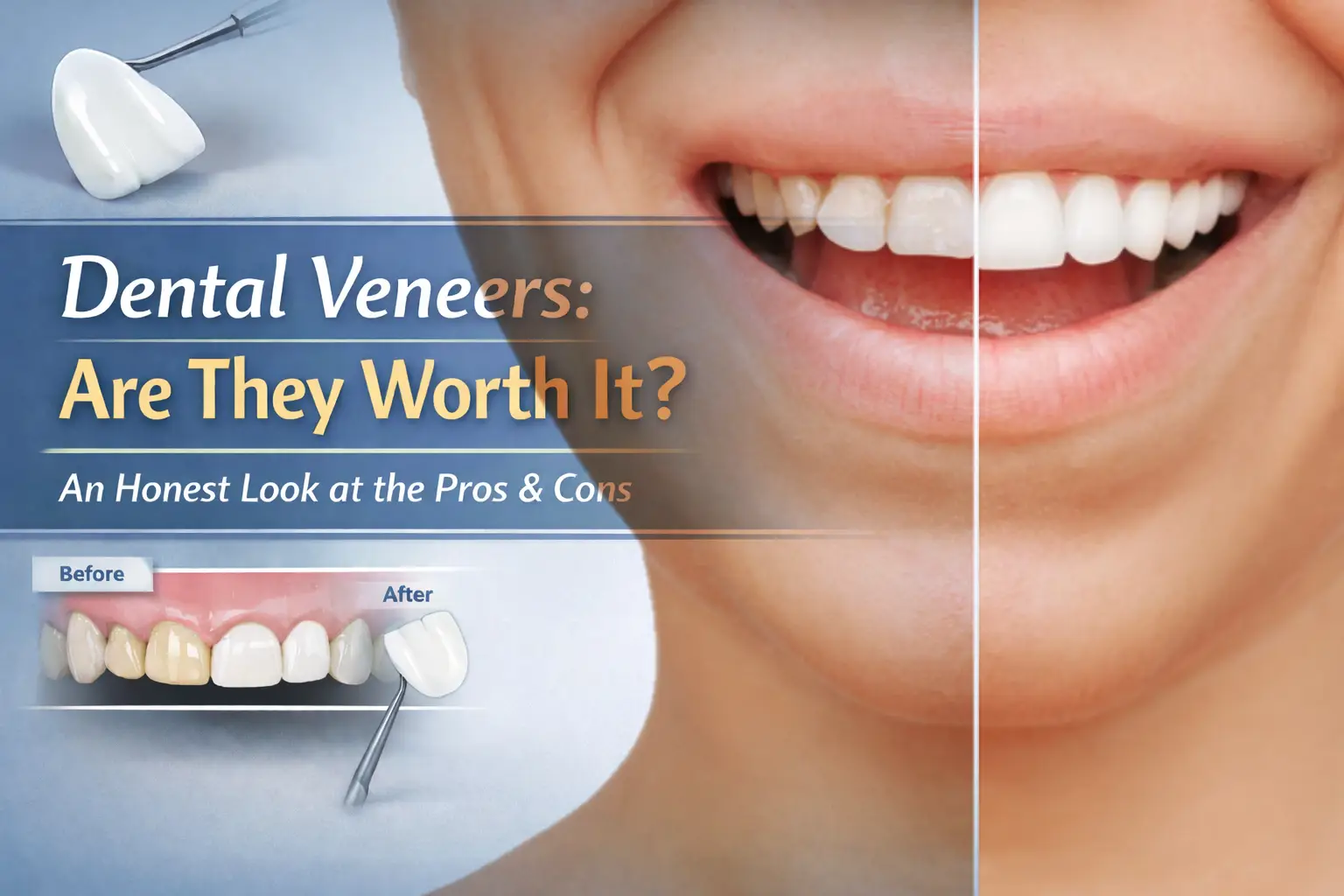
Few cosmetic dental treatments spark as much excitement and as many questions as dental veneers. Scroll through social media, and you’ll see flawless, bright smiles that look effortless. But behind every beautiful veneer case is a thoughtful decision that deserves more than a quick before-and-after photo.
At Almoney Dental Group, we believe patients make the best choices when they have the full picture, not just the highlight reel. Veneers can be life-changing. They can also be a serious commitment. This article walks through both sides honestly: the powerful advantages and the very real considerations you should think about before moving forward.
Our goal isn’t to convince you one way or the other. It’s to help you decide whether veneers are right for you.
What Are Dental Veneers?
Dental veneers are thin shells, typically made of porcelain or high-quality ceramic, bonded to the front surface of your teeth. They are custom-designed to improve:
- Color
- Shape
- Size
- Alignment
- Symmetry
They are often used to correct:
- Severely stained teeth that whitening cannot fix
- Chipped or worn-down teeth
- Gaps between teeth
- Mild misalignment
- Teeth that appear too small or uneven
Unlike whitening or bonding, veneers provide a comprehensive cosmetic transformation in a relatively short amount of time.
The Strong Case for Veneers: Why So Many Patients Love Them
Let’s start with why veneers are so popular, and why, for many patients, they are absolutely worth it.
1. They Deliver Dramatic, Predictable Results
Some cosmetic treatments improve one aspect of your smile. Veneers improve almost everything at once.
If you’ve spent years feeling self-conscious about your teeth, hiding your smile in photos, covering your mouth when laughing, veneers can create a visible, immediate transformation. The change is not subtle.
For many patients, that visible change translates into something deeper: confidence.
Patients often say things like:
- “I finally smile without thinking about it.”
- “I didn’t realize how much I was holding back.”
- “It feels like the smile I was supposed to have.”
That psychological shift is powerful.
2. Veneers Look Natural — When Done Correctly
Modern porcelain veneers are not the bulky, opaque restorations of decades past. Today’s materials mimic:
- The translucency of enamel
- Natural light reflection
- Subtle color variations
- Realistic surface texture
When designed thoughtfully and proportioned correctly to your face, veneers don’t scream “cosmetic dentistry.” They simply look like healthy, beautiful teeth.
Customization is key. Shade, shape, and contour are tailored to the individual, not copied from a template.
3. They Resist Staining
Porcelain veneers are highly stain-resistant. Coffee, tea, wine, and other dark pigments do not penetrate porcelain the way they penetrate natural enamel.
If you’ve struggled with deep intrinsic stains or teeth that quickly discolor after whitening, veneers provide a long-term brightness that is far more stable than bleaching treatments.
4. They Are Durable
Porcelain veneers typically last 10–20 years with proper care. They are strong, bonded restorations designed to function like natural enamel.
With good oral hygiene and routine dental visits, many patients enjoy their veneers for well over a decade before considering replacement.
5. They Can Be Conservative Compared to Crowns
Unlike crowns, which cover the entire tooth, veneers require minimal tooth reduction, typically only from the front surface. In many cases, much of the natural tooth structure remains intact.
For cosmetic improvements where teeth are otherwise healthy, veneers can be a more conservative option than full-coverage crowns.
6. They Can Be Life-Changing for the Right Candidate
For patients with:
- Enamel defects
- Genetic discoloration
- Multiple chipped or worn teeth
- Long-standing aesthetic concerns
Veneers can provide a level of improvement that no other single treatment can match. And that’s the honest truth: for the right person, veneers are transformative.
The Honest Side: What You Need to Consider Before Getting Veneers
Now let’s talk about what is less frequently discussed, the long-term considerations that deserve equal attention. These are not reasons to avoid veneers automatically. They are factors to weigh thoughtfully.
1. What Happens to Veneers as You Age?
Your veneers won’t age. But you will. Over time, natural facial changes occur:
- Lips thin.
- Skin loses elasticity.
- Jaw structure subtly shifts.
- Bite patterns evolve.
Veneers are designed for how your smile looks today. Twenty years from now, your facial proportions may be different.
Some patients worry:
- Will my veneers look too big as my lips thin?
- Will they appear too bright compared to natural aging teeth?
- Will my smile still look harmonious with my face?
In most cases, well-designed veneers continue to look beautiful as patients age. However, this is why conservative, natural-looking design is so important. Overly large or extremely bright veneers are more likely to look artificial over time.
This is not a reason to avoid veneers, but it is a reminder that subtle, balanced aesthetics age better than extreme makeovers.
2. Gum Recession Can Affect Appearance
Gums naturally recede with age to some degree. It can also occur due to:
- Aggressive brushing
- Gum disease
- Genetics
- Grinding or bite issues
If gum recession occurs after veneers are placed, it may expose the margin where the veneer meets the tooth. That can create:
- A visible line near the gumline
- Slight color differences
- Increased sensitivity
In many cases, this is manageable. But it’s important to understand that veneers rely on stable gum health for optimal long-term appearance.
Patients with active periodontal disease or significant gum recession may need to address gum health before considering veneers. Healthy gums are the foundation of a beautiful veneer case.
3. Veneers Do Not Last Forever
This is one of the most important realities. Veneers are durable, but they are not permanent.
Over time:
- Bonding can weaken
- Teeth underneath can develop decay
- Bite changes can stress restorations
- Edges may chip or wear
Eventually, most veneers will need replacement.
Replacement is typically straightforward, but it is still a future commitment. Since a thin layer of enamel is removed during preparation, veneers are not reversible. Once placed, you will always need some form of restoration on those teeth.
For many patients, this is a completely acceptable trade-off. For others, the idea of lifelong maintenance feels significant.
Understanding that veneers are a long-term relationship, not a one-time event, helps you plan responsibly.
4. The Financial Commitment — Now and Later
Veneers are an investment. And that investment doesn’t end the day they’re placed.
You should consider:
- Initial cost
- Potential future replacement
- Ongoing maintenance
- Possible repairs
Some patients worry about feeling “locked in.” Since enamel is altered, returning to untreated natural teeth is not an option.
It’s worth asking yourself:
- Will I be comfortable maintaining these long-term?
- If they need replacement in 15 years, will I be prepared for that?
For many people, the confidence and satisfaction they gain far outweigh the financial commitment. For others, a less invasive option like whitening, bonding, or orthodontics may feel more aligned with their goals.
There is no right or wrong answer. Only what fits your life.
Who Is a Good Candidate for Veneers?
You may be a strong candidate if:
- Your teeth are healthy overall.
- You have realistic expectations.
- You want a comprehensive cosmetic improvement.
- You understand the long-term commitment.
- Your gums are stable and healthy.
- You do not have uncontrolled grinding or severe bite issues.
Veneers are often ideal for people who have multiple aesthetic concerns at once and want a cohesive solution rather than piecing together several smaller treatments.
Who Might Want to Consider Alternatives?
You may want to explore other options if:
- Your main concern is simple discoloration (whitening may suffice).
- You have significant gum disease.
- You grind heavily and are unwilling to wear a nightguard.
- You prefer a reversible cosmetic option.
- You feel uncertain about committing to long-term maintenance.
In some cases, orthodontics, bonding, contouring, or crowns may be better suited to your specific needs.
The Emotional Side of the Decision
There’s a practical side to veneers: cost, durability, and maintenance. But there’s also an emotional side.
Ask yourself:
- How long have I been unhappy with my smile?
- Does it affect how I show up socially or professionally?
- Am I seeking perfection, or improvement?
- Am I doing this for myself?
Veneers are not about chasing trends. They are about alignment, how your smile reflects how you feel inside.
Some patients walk in knowing instantly that veneers are right for them. Others feel relieved after realizing that a simpler treatment will meet their needs.
Both outcomes are wins.
The Bottom Line: Are Veneers Worth It?
Veneers are worth it for people who:
- Understand the long-term commitment.
- Have healthy teeth and gums.
- Want a dramatic cosmetic upgrade.
- Value confidence and aesthetic harmony.
- Are prepared for maintenance and eventual replacement.
They may not be worth it for people who:
- Want a temporary or reversible solution.
- Are unsure about committing financially long-term.
- Have untreated gum or bite issues.
- Expect veneers to solve problems beyond aesthetics.
There is no universal answer. There is only your answer.
How Almoney Dental Group Approaches Veneers
At Almoney Dental Group, we believe cosmetic dentistry should feel collaborative, not pressured.
That means:
- A thorough evaluation of your oral health
- Honest conversations about risks and benefits
- Discussion of alternatives
- Customized smile design tailored to your face
- Long-term planning, not short-term sales
If veneers are right for you, we’ll explain why. If they aren’t, we’ll say that too.
Your smile should feel like an informed decision, not an impulse.
Considering Veneers? Let’s Talk.
If you’re thinking about veneers and want a thoughtful, pressure-free consultation, schedule an appointment with Almoney Dental Group.
We’ll walk through your goals, evaluate your smile, and help you understand whether veneers or another option is the right fit for you.
A beautiful smile is powerful. An informed decision is even more powerful.